a tale of two cornells͏‌ ͏‌ ͏‌ ͏‌ ͏‌ ͏‌ ͏‌ ͏‌ ͏‌ ͏‌ ͏‌ ͏‌ ͏‌ ͏‌ ͏‌ ͏‌ ͏‌ ͏‌ ͏‌ ͏‌ ͏‌ ͏‌ ͏‌ ͏‌ ͏‌ ͏‌ ͏‌ ͏‌ ͏‌ ͏‌ ͏‌ ͏‌ ͏‌ ͏‌ ͏‌ ͏‌ ͏‌ ͏‌ ͏‌ ͏‌ ͏‌ ͏‌ ͏‌ ͏‌ ͏‌ ͏‌ ͏‌ ͏‌ ͏‌ ͏‌ ͏‌ ͏‌ ͏‌ ͏‌ ͏‌ ͏‌ ͏‌ ͏‌ ͏‌ ͏‌ ͏‌ ͏‌ ͏‌ ͏‌ ͏‌ ͏‌ ͏‌ ͏‌ ͏‌ ͏‌ ͏‌ ͏‌ ͏‌ ͏‌ ͏‌ ͏‌ ͏‌ ͏‌ ͏‌ ͏‌ ͏‌ ͏‌ ͏‌ ͏‌ ͏‌ ͏‌ ͏‌ ͏‌ ͏‌ ͏‌ ͏‌ ͏‌ ͏‌ ͏‌ ͏‌ ͏‌ ͏‌ ͏‌ ͏‌ ͏‌ ͏‌ ͏‌ ͏‌ ͏‌ ͏‌ ͏‌ ͏‌ ͏‌ ͏‌ ͏‌ ͏‌ ͏‌ ͏‌ ͏‌ ͏‌ ͏‌ ͏‌ ͏‌ ͏‌ ͏‌ ͏‌ ͏‌ ͏‌ ͏‌ ͏‌ ͏‌ ͏‌ ͏‌ ͏‌ ͏‌ ͏‌ ͏‌ ͏‌ ͏‌ ͏‌ ͏‌ ͏‌ ͏‌ ͏‌ ͏‌ ͏‌ ͏‌ ͏‌ ͏‌ ͏‌ ͏‌ ͏‌ ͏‌ ͏‌ ͏‌ ͏‌ ͏‌ ͏‌ ͏‌ ͏‌ ͏‌ ͏‌ ͏‌ ͏‌ ͏‌ ͏‌ ͏‌ ͏‌ ͏‌ ͏‌ ͏‌ ͏‌ ͏‌ ͏‌ ͏‌ ͏‌ ͏‌ ͏‌ ͏‌ ͏‌ ͏‌ ͏‌ ͏‌ ͏‌ ͏‌ ͏‌ ͏‌ ͏‌ ͏‌ ͏‌ ͏‌ ͏‌ ͏‌ ͏‌ ͏‌ ͏‌ ͏‌ ͏‌ ͏‌ ͏‌ ͏‌ ͏‌ ͏‌ ͏‌ ͏‌ ͏‌ ͏‌ ͏‌ ͏‌ ͏‌ ͏‌ ͏‌ ͏‌ ͏‌ ͏‌ ͏‌ ͏‌ ͏‌ ͏‌ ͏‌ ͏‌ ͏‌ ͏‌ ͏‌ ͏‌ ͏‌ ͏‌ ͏‌ ͏‌ ͏‌ ͏‌ ͏‌ ͏‌ ͏‌ ͏‌ ͏‌ ͏‌ ͏‌ ͏‌ ͏‌ ͏‌ ͏‌ ͏‌ ͏‌ ͏‌ ͏‌ ͏‌ ͏‌ ͏‌ ͏‌ ͏‌ ͏‌ ͏‌ ͏‌ ͏‌ ͏‌ ͏‌ ͏‌ ͏‌ ͏‌ 
Cornell on Fire

a tale of two cornells

Dear Cornell on Fire,

Two of Cornell’s governing bodies weighed in on Cornell’s State of Sustainability this month, and their conclusions could not have been more divergent. As the administration doubled down on their well-intentioned incrementalism, the Student Assembly had enough: they advanced a resolution to dramatically expand and accelerate Cornell’s Climate Action Plan. In another case of idealists versus hard-nosed realists, we bring good tidings: the students (the realists) are right, and a new white paper on Cornell’s Heating Decarbonization pathways underscores the strength of their case.

The sun is always shining when Cornell’s administrators take the stage to expound on progress toward “carbon neutrality” (a problematic concept, much-liked by greenwashers). On December 9, administrators led by Rick Burgess, Vice President of Facilities and Campus Services, delivered yet another bubbly State of Sustainability Address. The Cornell they spoke of boasts year-on-year platinum STARS ratings and progresses splendidly towards carbon neutrality, at least as depicted in a “beautiful graphic” without numbers. As for the numbers: it was actually suggested (without a trace of irony) that it might be “reductionist” to focus on reducing Cornell’s own carbon footprint.

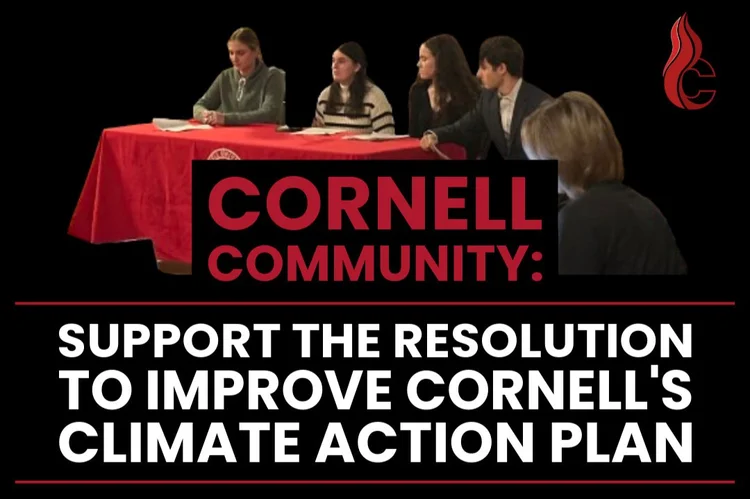
The students see through this. On December 5, the Student Assembly adopted a resolution to renew Cornell’s Climate Vows (inspired by our demands). The Cornell they speak of is considerably less starry than that of the administrators: the university systematically underreports its emissions, excludes the vast majority of its carbon footprint from its climate action plan, and is not progressing as promised. The resolution lays out forward-looking proposals for improvement including (1) adopt sustainability as a core institutional goal (translation: put your money where your mouth is); and (2) decarbonize now. 

As winter arrives in Ithaca, all our heaters are hard at work, bringing one of the key disagreements into stark relief: When should Cornell start decarbonizing its campus heating systems? Cornell’s flagship heating decarbonization project, Earth Source Heat, remains experimental. If successful, it will only (optimistically) serve the campus by 2035. What should Cornell do in the interim? 

This question is as weighty as the manifold new construction projects on campus. Look around at the sprawling chaos of new buildings rewriting the ecosystem on The Hill. Not only does each building grind its concrete foot into the face of Cornell’s 2013 climate pledge to reduce new construction (such a quaint notion!) – but they add insult to injury by using fracked gas from Cornell’s Combined Heat and Power Plant for heating, rather than decarbonizing with heat pumps. 

The Student Assembly resolution calls for immediate decarbonization of all new construction. So does the Ithaca Energy Code Supplement (IECS). Informally known as Ithaca’s “Green Building Code,” the IECS mandates fossil-fuel phaseout in all new construction and major renovations. You would think that Cornell, self-proclaimed climate leader, would embrace this law wholeheartedly. Quite the opposite. Cornell has submitted amendments to make themselves exempt from Ithaca’s fossil-fuel phaseout. Their argument? When not presenting Earth Source Heat as the solution (never mind its delay), they claim that their hands are tied, because regrettable features of the NY electricity grid mean that decarbonization at Cornell would backfire by increasing grid emissions elsewhere. For years, Cornell’s scientists and local environmentalists have argued that they are wrong, and that Cornell’s delayed decarbonization strategy carries tremendous emissions costs. 

The answer can only be found by modeling the emissions associated with each decarbonization pathway. (Cornell’s administrators have provided no such modeling to support their claims.) 

Fortunately, Cornell engineers and a University of Illinois statistician have just delivered a gift to Cornell’s decision makers: a white paper that models the emissions associated with Cornell’s two possible decarbonization pathways (immediate vs. delayed). They find that immediate decarbonization does save carbon emissions – significantly – in all cases tested and under all NY grid projections.  

The white paper makes three contributions to Cornell’s – and Ithaca’s – decarbonization pathways: 

  1. It supports a key ask of the Student Assembly Resolution and Cornell on Fire Demands.

  2. It supports the integrity of Ithaca’s Green Building Code as currently written.

  3. It reveals that Cornell’s delayed decarbonization is costly for people and planet, and may cost Cornell and Ithaca its climate goals.

Cornell’s decision makers need to take full accountability for the steep climate and social costs of their business-as-usual approach to heating new construction with fossil fuels. 

Strike another victory for the students, who have once again outpaced Cornell’s administrators in Reality 101. As one Student Assembly member noted (paraphrasing), “this will be the most important piece of legislation we’ve passed all year.” Their tale is the one that Cornell needs to hear: the climate emergency is real, immediate decarbonization is required, and a qualitative break from administrators’ business-as-usual attitude is imperative.

Happy winter,

Cornell on Fire

*The curious reader can find supplemental notes in our corresponding blog post.

Support the Student Assembly Vote on the Resolution to improve Cornell's Climate Action Plan:

Join us at the Student Assembly meeting on January 23, 2025 (4:45-6:00 pm), Willard Straight Hall Memorial Room (407). All members of the Cornell community and public can join to watch the meeting and/or give public comments in support of the resolution. The Cornell on Fire: Eco Justice Solidarity Program has created an optional RSVP form with useful information here! 

  • Are you a faculty or staff member interested in introducing a similar resolution to your respective Senate/Assembly at Cornell? Please email us at connect@cornellonfire.org.

Time is precious. End-of-year Donation Call:

The most effective gift you can give our movement is your acuity, moral outrage, and willingness to act on what earth and science tell us. These gifts are especially effective when they manifest in the dimension of time. Please click here to donate minutes or hours of your time to our movement and allies. Don’t miss this gratifying list of options for time-spending! 

Learn more about the real state of university sustainability:

  • At Cornell:

    • Read our reports on the state of climate action at Cornell. What you need to know to demand the change we need.

    • Read the new student analysis of climate-related courses in Freshman Writing Seminars. It reveals incremental progress, with much work to be done.

  • Beyond Cornell, there is increasing awareness that sustainability needs to reach a new state:

    • Check out the launch celebration and discussion of the new book Climate Justice and the University by Jennie C. Stephens, Professor of Climate Justice, National University of Ireland Maynooth. Building on the sobering acknowledgement that “universities are not yet structured to accelerate social change for the public good,” the book outlines how they might do so. 

    • Bryan Alexander’s book Universities on Fire: Higher Education in the Climate Crisis won the prestigious Frederic W. Ness Book Award from the American Association of Colleges and Universities. An encouraging sign that at least some higher education officials are breaking from rose-colored assessments of university “sustainability” and updating their worldview to accommodate our climate-disrupted reality. (Our movement name draws its inspiration from Bryan’s book and we’re honored that he serves as one of our movement advisors.) 

Engage the Wider Movement:

  • Join concerned citizens and scientists in opposing Cornell’s newest proposal for yet more artificial turf fields. Their latest proposal is currently under review by the Ithaca Town Planning Board despite an ongoing lawsuit. We need to submit a strong set of written public comments to the Planning Board in advance of their next meetings on January 7. Write to Zero Waste Ithaca (info@zerowasteithaca.org ) or Cornell on Fire (connect@cornellonfire.org) to get involved with next steps. 

  • Extinction Rebellion Climate Vigils 11am every Saturday at Chase Bank - the worst bank on Earth - at the East end of the Ithaca Commons.

  • Earth to Biden: Declare a Climate Emergency. Scientist Rebellion Turtle Island is about to close their petition to President Biden pressuring him to declare a climate emergency before he leaves office. Please sign it and share it with friends, family, everyone you know, before the end of the year!

In case you missed it … catch up on our latest work:

  • Check out our latest communications:

    • Cornell on Fire Post 11/6: On Love and Rage

    • Newsletter #11: Thanksgiving and Mourning

    • Cornell on Fire Post 12/6: AD White weighs in on the expressive policy

    • Position Statement: Don’t Muzzle Us (response to the draft Expressive Activity Policy)

  • Check out our latest actions: 

    • AD White Action 12/6

    • Climate Superfund Sit-in in Albany 12/10

Thank you for reading this far and engaging in the number-one frontline for climate action: your attention.

Opt for future communications

Hearing from us for the first time? We’re reaching out because your work or studies are relevant to the questions at hand. This listserv is 100% handmade, not scraped by a bot.

  • Opt in here and choose your email frequency (monthly or weekly).

  • Opt out of all communications by clicking “unsubscribe” below

  • Do nothing: enjoy rare announcements like this one

Newsletter #12 originally published on December 30, 2024.

Opt out of Cornell on Fire Newsletters: write “unsubscribe” to connect@cornellonfire.org or click “unsubscribe” below.

 
 JOIN US 
 

Cornell on Fire
an independent movement affiliated with Earth, inspired by Cornell and its community
Gayogo̱hó:nǫɁ Homelands | Ithaca, NY
US

Powered by Squarespace

Unsubscribe

Cornell on Fire