
Cornell reverses stance on heat electrification, announces the plan we’ve advocated for
Breaking News published on November 20, 2026
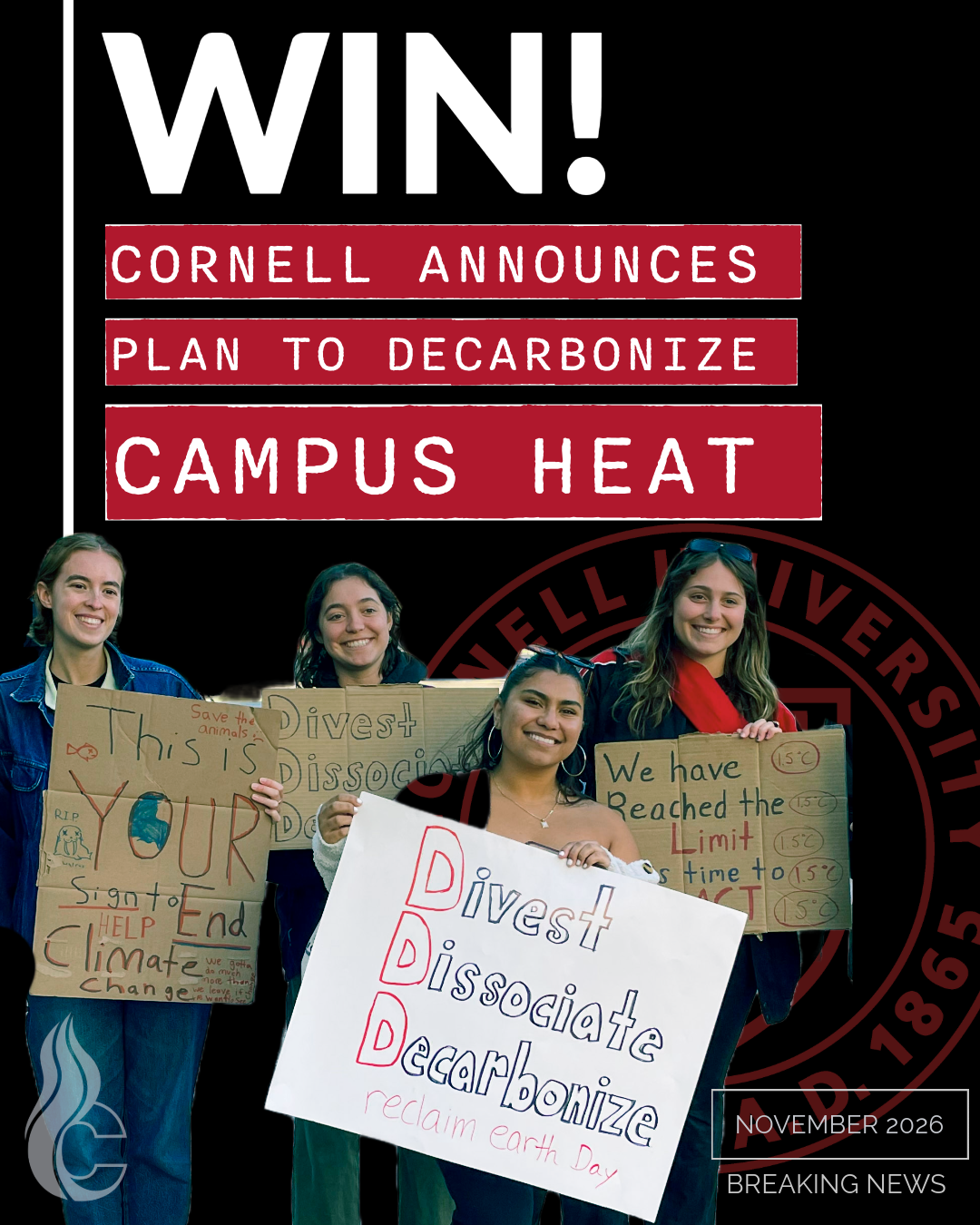
Cornell’s decision to implement heat electrification is a huge win for the climate (and climate activists). Heat electrification has been the touchstone of debates between climate activists, Ithaca, and Cornell. Now, the University will move forward with electrification. However, important questions remain as to whether these solutions will be implemented fast enough for Cornell to comply with the Ithaca Green New Deal and Cornell’s own commitment to carbon neutrality by 2035. Furthermore, Cornell (and all of us) must go beyond technical solutions to fundamentally change excessive lifestyles in favor of climate justice.
Dear Cornell Community,
Two days ago, Cornell announced a historic plan to advance campus decarbonization by electrifying heat. This represents a victory for Cornell on Fire, the Student Assembly, and Ithaca’s Green New Deal —we all worked hard to reverse Cornell’s public opposition to heat electrification.
The Cornell Chronicle announced on Wednesday that the Board of Trustees has approved a $1.1 billion capital investment for a 40-year energy transition plan that pivots on borehole thermal energy storage (BTES). BTES will electrify heat and reduce carbon emissions, using an improvement upon the shallow geothermal heat pumps that we’ve been advocating for.
The announcement comes not a moment too soon. As recently detailed in our Cornell Sun op-ed, Cornell is 19 years into its Climate Action Plan and several years behind on its climate goals. Equally crucial, we are eleven months past the Ithaca Green New Deal’s original start date for fossil-fuel phaseout in new construction. Until now, Cornell has actively opposed the City’s climate goals by seeking an exemption from the fossil-fuel phaseout. They argued that phasing out direct use of fossil fuels through campus heat electrification would be worse for the climate than continuing to use their own fracked gas-fired power plant.
Yes, you read that right. In January 2025, Cornell’s President Kotlikoff publicly argued that campus heat electrification is bad for the climate. In his words: “Electricity-based alternatives will not reduce our reliance on carbon-emitting fuels” and Cornell should delay decarbonization because “any additional demands to the grid now will result, for the foreseeable future, in grid-connected gas-fired plants increasing their electricity generation.”*
Kotlikoff’s argument against heat electrification was incorrect, as pointed out in our public response. The argument parroted Big Oil’s misinformation and contradicted Cornell’s own experts. In fact, Kotlikoff’s op-ed was an unstated response to a white paper we had disseminated three weeks prior. In that paper, Cornell engineering experts and activists modeled the carbon emissions consequences of heat electrification versus business as usual at Cornell’s power plant. The findings were consistent with established understandings of decarbonization, Ithaca’s Green New Deal, and Cornell’s own internal recommendations: namely, that ground source heat pumps are a viable plan to reduce campus emissions.** Now that Cornell is moving forward with heat electrification, will Kotlikoff publicly correct his stance against it?
This announcement represents the hard work of many from within and outside of Cornell. Over the past two years, we have researched decarbonization pathways, written op-eds, offered updates, given public presentations to organizations such as the Tompkins County Climate Protection Initiative (TCCPI) and the County’s Climate and Sustainable Energy Advisory Board (CASE), distributed an information packet to over 70 local decision makers, and received 120 signatures on a petition for Cornell to decarbonize now, in line with the City’s green building policy. The Student Assembly passed a unanimous resolution urging Cornell to accelerate decarbonization and demonstrate climate leadership. Our collective efforts have paid off.
Just as pressure from Cornell and Ithaca community members played an important role in pushing Cornell to announce this energy transition, it’s also essential to ensuring that they follow through with it. We must demand sustained public transparency on funding and resources for the project, recalling how Earth Source Heat was sidelined through Cornell’s lack of investment. While Cornell’s Energy Team is working on solutions, pressure from the outside is essential to ensure that climate remains a priority.
Many big questions remain. Will Cornell’s energy transition roll out in time to meet their 2035 carbon neutrality commitment? Does Cornell now plan to comply with Ithaca’s fossil-fuel phaseout in new construction? While Cornell’s decision to electrify heat would seem to be a welcome reversal of their vexing opposition to Ithaca’s fossil-fuel phaseout, the announcement did not explicitly mention their intention to comply with Ithaca’s green building code.
While we celebrate this win, we have miles to go before Cornell achieves its climate goals or demonstrates the leadership we need and expect from a globally-renowned research institution with significant cultural influence. Cornell’s commitment to emissions reduction needs to go beyond Scope 1 to include their gargantuan Scope 3 carbon footprint, from air travel and procurement to throwaway culture and construction.
Associate VP of Energy and Sustainability Cole Tucker noted that boring 1,800 boreholes and replacing miles of pipes would “not [be] a trivial exercise.” Yet as hard as it is to find $1.1 billion dollars and restructure the very groundwork of campus, this is ultimately an easy task for our “solutions” oriented society. We still have not done the hardest thing: to give up the luxuries and excesses delivered by a historically unprecedented “standard of living” that steals life from other beings.
It’s good to decarbonize heat. But we must also make brave tradeoffs in favor of slowing down, simplifying, staying local, sharing, and degrowth.
Electrifyingly,
Cornell on Fire
*Asterisks indicate where supplemental notes can be found by scrolling below. You can like this special breaking news announcement and other posts on Instagram and Mastodon.
Who is Cornell on Fire?
We are a campus-community coalition calling on Cornell to confront the climate emergency. We meet biweekly at St. Luke Lutheran Church in Collegetown (109 Oak Avenue.) We also meet hybrid - email us if you’d like the link.
Interested in joining us? We actively welcome new perspectives. Everyone can contribute to our campus-community coalition: students, staff, faculty, alumni, and community members. Fill out our interest form or reach out at connect@cornellonfire.org.
Follow us on social media via Instagram, Mastodon, and YouTube.
Click here to share an anonymous tip
Supplemental Notes
*Kotlikoff’s ostensive concern about “additional demands to the grid” did not prevent Cornell from moving forward with a massive new AI subscription that will carry exorbitant carbon emissions, citing the need to “stay competitive” and ignoring the need to “stay livable” (on earth).
**For instance, a 2016 University report on campus decarbonization acknowledged that the flagship Earth Source Heat Project might not work and named ground source heat pumps as Plan B.
Thank you for reading this far and engaging in the number-one frontline for climate action: your attention.
Special Breaking News Announcement originally published on November 20, 2026.