Cornell Sustainability Summit: Seasonal Sadness
We expect an honest accounting of progress
Dear Cornell Community,
This month, we find ourselves afflicted with seasonal sadness — not because the darkness lengthens, but because it’s that time of the year again for Cornell’s “Sustainability Summit.” On Monday, December 8, this year’s summit will focus on “our statewide energy transition and campus decarbonization.”
Why the sad face? In the past, we have been dismayed by Cornell’s approach to this event as a PR opportunity. The climate crisis is an existential tragedy exacting an unfathomable toll: to treat it as an opportunity for burnishing Cornell’s reputation while greenwashing over the University’s actual performance is reprehensible. This year, we expect Cornell’s leadership to instead recognize the gravity of the situation by taking accountability for their Climate Action Plan and providing an accurate, quantitative report on their progress (or lack thereof) towards climate goals.
Cornell prides itself on the “platinum” rating it achieves annually in STARS (AASHE’s Sustainability Tracking, Assessment & Rating System). Unfortunately, this rating is based entirely on self-reporting and belies deep problems with Cornell’s actual emissions and climate change education. Here are six key questions we expect to see addressed in the Summit:
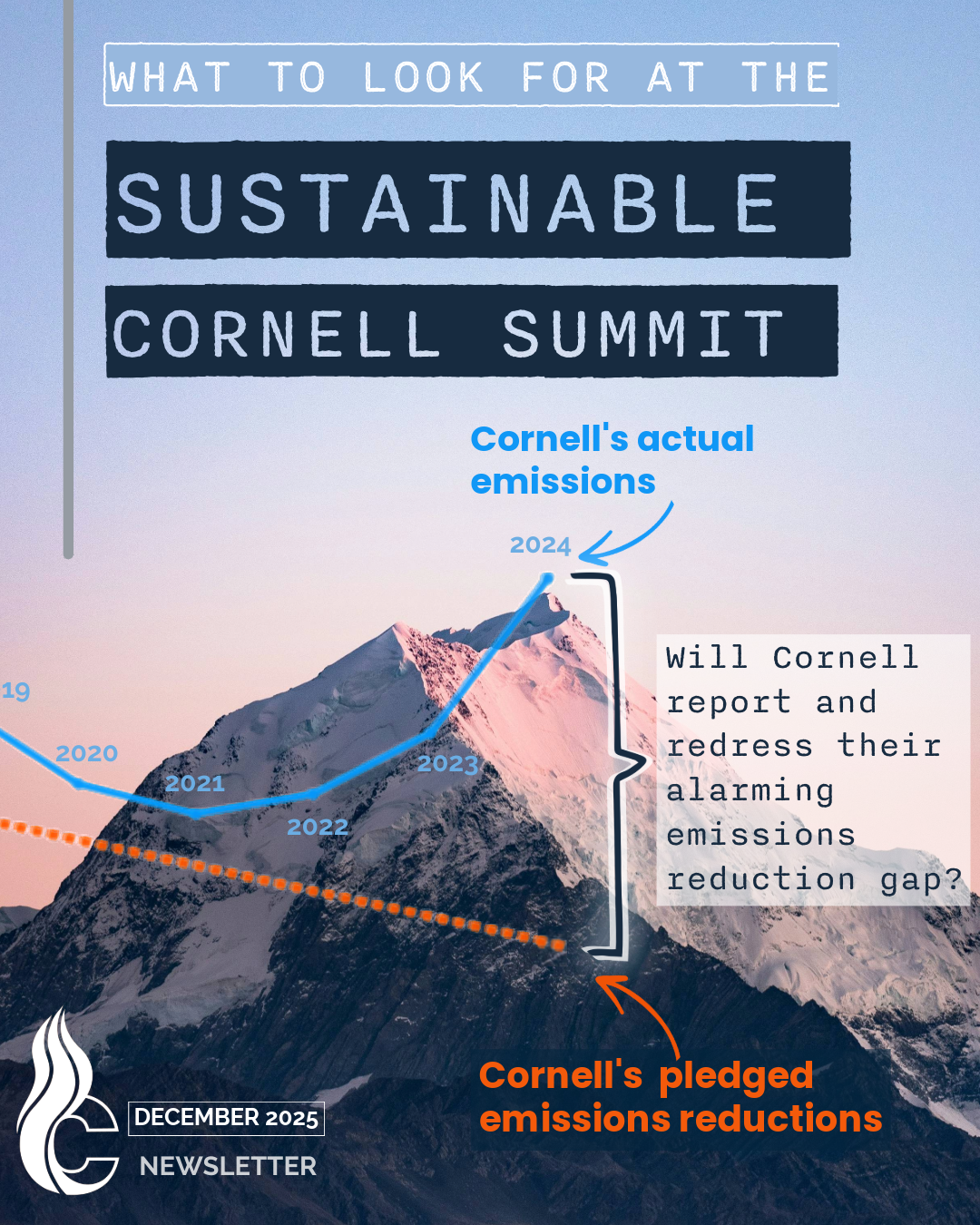
Why is Cornell so far behind on their climate goals, and what will they do to close the gap? Cornell’s external progress reporting generates one key outcome measure: a SIMAP graph that plots actual progress against climate goals. This graph shows that Cornell is not on track to their climate goals – their emissions reduction gap is over 100,000 mtCO2e and growing. Yet Cornell has not published this key graph on their Sustainable Campus webpage, nor mentioned it in any recent State of Sustainability addresses. We expect this to be the centerpiece of any Sustainable Cornell Summit: “Here’s where we promised to be; here’s where we actually are; here's why we have failed to deliver so far; and here’s how we will change to close the gap.”
Why isn’t Cornell reporting the full scope of methane emissions from their power plant in line with their own recommendations and New York State Law? The key plot just mentioned above underestimates Cornell’s actual emissions, because Cornell still doesn’t take accountability for the full scope of methane emissions from their power plant, as they should according to New York's Climate Law and Cornell’s own recommendations. If upstream methane emissions were reported accurately, we would find that Cornell has not reduced emissions at all since it began tracking progress in 2008. At this year’s summit, we want to know: When will Cornell stop replicating Big Oil’s false narrative (condemned by Congress) that natural gas is a “lower-carbon” “bridge fuel” that has “reduced” campus emissions?
Will Cornell comply with Ithaca’s fossil-fuel phaseout in new construction starting January 1, 2026, as research shows will reduce emissions?* We hope to see Cornell abandon their misguided attempts to exempt themselves from the phaseout, and stop using the same faulty methodology as Big Oil to claim that their gas plant is better for the climate than heat pumps.
Will the long-awaited final report of the Curriculum Working Group on Climate Change present rigorous criteria for rating courses on sustainability and recommend a university-wide requirement in climate education, as at other universities? Our research reveals a lack of transparency in Cornell’s (self-)reporting on courses that address “sustainability,” while other courses actively promote fossil-fuel industry greenwashing, undermining the University’s vaunted platinum STARS rating on climate curriculum.
Cornell’s current institutional embrace of the so-called “AI” technologies (in itself an irresponsible administrative imposition on faculty and students’ practices) contributes to global warming and detracts from community well-being due to the devastating impact of “AI” data centers on the environment and cost of living. Will Cornell reverse this policy and side with the people rather than with oligarchs enriching themselves further by peddling planet-killing snake oil?*
Will Cornell announce whether Earth Source Heat has been determined to be viable, and commit to either funding this project themselves or moving forward with Plan B? Cornell promotes Earth Source Heat (ESH) as the experimental technology that will decarbonize campus by harnessing deep geothermal heat. But its feasibility remains uncertain. According to Cornell’s 2016 report, the question of ESH feasibility should have been settled by now so that Plan B (ground-source heat pumps) could be implemented in time to meet Cornell’s carbon “neutrality” goal.* At this year’s summit, we expect Cornell to show us (not tell us) that decarbonization is important to them by unveiling a funding plan for ESH that prioritizes decarbonization over other internal spending categories (like new buildings*) and does not rely dangerously on external funding.
Will Cornell rise to the challenge of our times by declaring a climate emergency and honestly reporting – and redressing – their alarming emissions reduction gap? Doing so would earn it the respect of people of good will all over the world, position it as a true leader within U.S. higher education, and create a lasting legacy of global import.
With great expectations,
Cornell on Fire
*Asterisks indicate where supplemental notes can be found by scrolling below. Read on for actions, events, and updates! This newsletter was also published via email and social media on Instagram and Mastodon.
Get involved with Cornell on Fire:
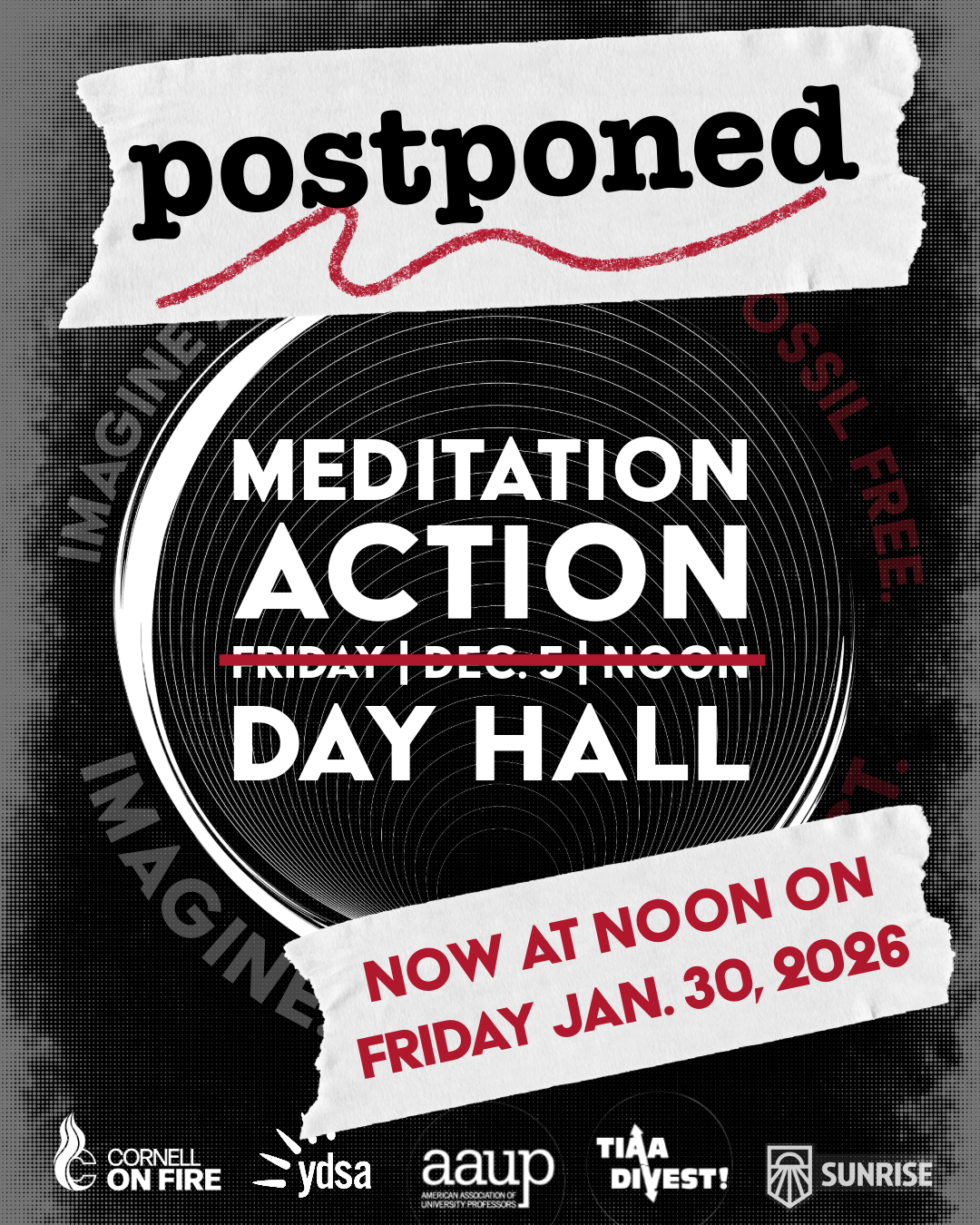
Meditation Action for a Fossil-Free Degree: Friday, 1/30, 12-1pm in front of Day Hall. (Note the change in date from Dec. 5th to Jan. 30th!) Get enlightened at an unusual meditation: Join a 40-minute sitting-and-walking outdoor meditation led by an accomplished meditator, attended by an exclusive group of Cornell trustees and senior administrators. Learn more and RSVP here. (RSVPs are optional but will help us better prepare for your serenity amid climate breakdown.) An unusual event co-sponsored by Cornell on Fire, Sunrise Cornell, Cornell YDSA, TIAA-Divest!, and the Cornell Chapter of the AAUP, inspired by Oli Frost and fossil-entangled Corporate Cornell.
Cornell on Fire Social: Sunday, 12/7, 4-6pm at Personal Best Brewery. A space to unwind and enjoy good company with fellow activists. Welcome!
Interested in joining our Working Group? We meet weekly and actively welcome new perspectives! Everyone can contribute to our campus-community coalition: students, staff, faculty, alumni, and community members. Fill out our interest form or reach out at connect@cornellonfire.org.
Join Cornell on Fire as a climate justice liaison. Our movement receives coalition requests from powerful movers and shakers on campus and beyond, such as the Rainforest Action Network, Campus Climate Network, and Scientist Rebellion Turtle Island. We need liaisons who can connect our work to theirs! This is a concrete way to support Cornell on Fire while driving the larger movement for climate justice. It’s easy: fill out our interest form to become a liaison who joins ally meetings and reports back to us.
Contribute your creative skills to Cornell on Fire’s art-ivism project: We are seeking people with design and artistic skills to help create humorous, critical, multi-media artworks for a public exhibit about Cornell’s shortcomings in the face of the climate emergency and CoF demands. Get in touch with Leila at l.wilmers@gmail.com for details!
Engage the Wider Movement:
Stop the TerraWulf Takeover on Cayuga Lake - and why it’s connected to Cornell: Local environmental allies are fighting a David-and-Goliath fight against TerraWulf’s data center plans in Lansing. TerraWulf is threatening lawsuits against town board members, disparaging town representatives and local reporters, and greasing the wheels with donations and tax revenue promises. Data centers’ high energy consumption jeopardizes our climate goals and increases utility prices while generating carbon emissions; noise, air and water pollution; and toxic e-waste that can seep into soil and groundwater. Data-center-driven AI is doubly extractive: it steals intellectual property from the working class while driving unemployment and cratering education.
What’s the connection to Cornell? According to our allies at TIAA-Divest, Cornell's major retirement fund, TIAA, identifies AI as a key driver of investment opportunities. TIAA’s portfolio includes substantial investments in data centers which are not apparent to those with TIAA accounts (people who have chosen real estate funds will not know that these accounts include AI data centers). In Aug. 2025, TIAA’s subsidiary Nuveen raised $1.3 billion for an energy and power infrastructure credit fund that will provide private credit to renewables, storage, hydrocarbon, and midstream and liquified natural gas companies benefiting from the AI boom. Private credit is unregulated and untransparent, unlike publicly traded stocks and bonds. There are lots of indicators that AI investments are a bubble, too, which will leave retirees with poor returns. If Cornell manages your tuition or your retirement funds, then you have a personal reason to oppose AI data centers like TerraWulf!
Stay plugged into the latest developments and take action withNo Data Center FLX, @PSL_FLX, TIAA-Divest!, and Cornell YDSA.
Extinction Rebellion Climate Vigils 11am most every Saturday at Chase Bank - the worst bank on Earth - at the East end of the Ithaca Commons.
In case you missed it. Catch up on our latest work:
Check out our latest communications:
Newsletter #23: The Settlement, TCAT, and Cornell’s Hypocrisy
Read the press coverage of our activities over the last months
Check out our latest actions:
Call to Action for TCAT: We blasted Cornell’s simultaneous betrayal of TCAT and their climate goals, asking our movement members to join Cornell YDSA’s phone zap. Our pressure helped! Days afterward, Cornell increased their offer - but not enough. Let’s keep up the pressure.
Fridays on Fire: Fight Bird Strike. Cornell climate activists fought bird strike and caught up with newcomers and oldcomers at our Fridays on Fire event. We introduced people to materials that can help prevent one of the largest killers of birds: windows. A collaboration between Cornell YDSA, Cornell on Fire, and Sunrise Cornell.
Cornell’s Climate Inaction Reviewed: Cornell on Fire Faculty Fellow Anthony Ingraffea presented on Cornell's (lack of) climate action to an engineering class. We published four key highlights and the results of a most revealing poll.
Follow our latest actions on social media: on Instagram, Mastodon, and YouTube.
Supplemental Notes
*Research shows that electrification of heat will reduce Cornell’s emissions. The invited keynote speaker at the Sustainable Cornell Summit, the CEO of Loudon Energy Analytics Rana Mukerji, describes his company’s mission as follows: “to bring cutting edge stochastic modeling and financial engineering tools to market and facilitate the transition to a sustainable and distributed grid.” This lofty language does not, however, sit well with Cornell’s practice of ignoring their own cutting-edge faculty experts, who have advised them on why their approach to gas-plant expansion is wrong. We hope to see Cornell announce an end to this expansion of a polluting energy source, and to propose solutions aligned with the best science on transitioning to a sustainable energy grid.
*On Cornell’s contradictory approach to AI: While Cornell the Corporation embraces the use of AI on an institutional level and celebrates its ability to create “efficiencies” (i.e., cut jobs), it also argues against the electrification of campus heating due, in part, to the presence of increased electricity demand from data centers leading to dirtier electricity. We share the acute concern that AI data centers jeopardize our climate goals, but credible analyses show that electrification of heat remains both beneficial and necessary under a range of future grid scenarios. Cornell should intensify their efforts to publicly oppose AI while supporting fossil-fuel phaseout policies; they should not capitulate in advance to overly pessimistic projections of a failed electricity transition (thus foreclosing with 100% certainty on a clean energy transition). And remember: these woes would largely be solved by the successful implementation of Earth Source Heat – this wouldn’t even be a debate if Cornell had already devoted adequate funding to the project’s success.
*Alternative solutions should be implemented in time to meet Cornell’s carbon “neutrality” goal. According to Cornell’s 2016 report, Plan B for campus decarbonization is ground-source heat pumps, the implementation of which “would need to commence by 2025 if the University is to achieve neutrality by 2035.” This goal makes the 2025 Sustainable Cornell Summit a particularly poignant one. Will Cornell representatives even mention this goal, or will they gloss over it by deflecting attention to statewide challenges?
*Cornell’s funding priorities ignore the climate. Cornell the Corporation spent over $337 million on new construction projects active or planned in 2024, while claiming they can’t fund campus decarbonization through Earth Source Heat (an estimated price tag of $100-200 million). In so doing, Cornell continues to ignore their own 2016 recommendations for university decision-making based on the social cost of carbon. There is no evidence to date that Cornell feels obligated to either intergenerational equity or the social cost of carbon. Quite the opposite.
Thank you for reading this far and engaging in the number-one frontline for climate action: your attention.
Newsletter #24 originally published on December 5, 2025.