The settlement, TCAT, and Cornell’s hypocrisy
Cornell’s Janus-faced principles
Newsletter #23 published November 25, 2025
Dear Cornell on Fire,
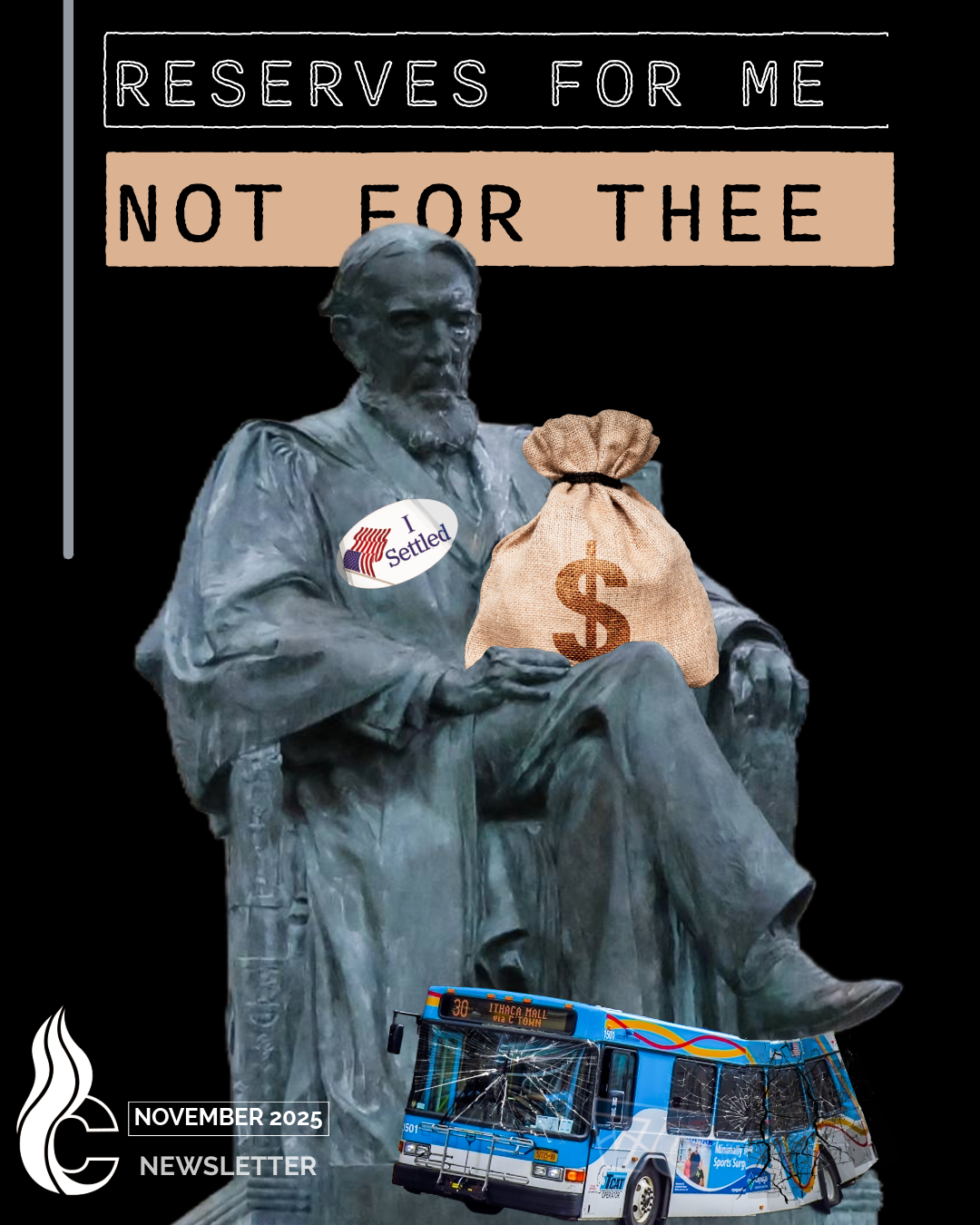
While Cornell’s corporate leadership held secret negotiations with an extortionist regime, their endowment ballooned to $11.8 billion. We asked, “What should Cornell leadership treat as untouchable: Their massive endowment or their core values?”
We got the administration’s answer on November 7: Cornell corporate leadership settled with Trump’s regime, cementing their place in history as the “leaders” who sold out on Cornell’s core values rather than mobilize the endowment in the face of federal funding cuts. Criticism rained down on all sides. The Cornell Chapter of the AAUP immediately issued a sharp analysis of the threatening implications for academic freedom, civil rights, diversity, and vulnerable students, while the Guardian reported that Cornell’s deal set a “dangerous precedent.” Cornell student groups decried the “anti-diversity, anti-trans policies” and warned that the settlement “threatens the security of student activism across the nation.” A new group called Cornell Courage circulated a critical legal analysis of the settlement with an open letter for signatures. (Please consider signing!)
Cornell could have protected their community and core values by taking the reasonable step of mobilizing the endowment rather than striking a deal with fascists. An analysis by Cornell Contingent Academic Workers points out that a modest adjustment to endowment payouts for an emergency period could have protected academic jobs under Trump’s funding cuts. Over 300 Cornellians signed a letter to the trustees in support of this emergency fund. Corporate leadership ignored it.
The same week they settled, Cornell publicly argued that reserves should be spent – TCAT’s reserves, that is. Cornell issued an “insulting” $31,000 counteroffer for TCAT bus operations rather than matching the City and County’s $500,000 contributions. The Ithaca Voice reports that “Cornell’s reticence” is due to the reserve funds TCAT holds: “The Cornell spokesperson said TCAT’s $500,000 request comes while TCAT has a ‘substantial fund balance.’”
Let’s reflect upon reserves for a moment. Who else holds a “substantial fund balance” in reserve? Would Cornell consider their $11.8 billion endowment “substantial?” Did they mobilize it to defend their core values, their workers, their vulnerable students, or their faculty’s academic freedom against a fascist regime? Absolutely not. Yet they are now using that very logic to twist TCAT’s arm into drawing down their astronomically more modest reserves, a move that would put TCAT in a “very catastrophic fiscal situation” in just two or three years according to TCAT’s General Manager. (Cornell recently upped their offer to $280,000, still representing only 56% of the full contribution requested by TCAT.)
The irony is painful, both for the raw hypocrisy of Cornell’s position and for its betrayal of the university’s own climate goals. Cornell's Climate Action Plan promotes low-carbon public commuting and commits to funding it. In 2013, Cornell representatives boasted that "We have the best public transit system for a community our size in the country" and noted that by "leading with a good example in Ithaca…[Cornell] can have widespread impacts in other regions” (pp. 58-59). Consequently, Cornell pledged the following as part of their commitment to carbon neutrality:
"Increase the use of mass transit by the Cornell community through the OmniRide Program and enhanced outreach for Cornell employees during the onboarding process."
"Develop and implement comprehensive strategies to support mass transit in Tompkins County and increase ridership."
Now, Cornell’s miserly offer betrays their Climate Action Plan and compromises TCAT’s ability to deliver low-carbon mass transit. It also betrays the community that hosts them – Cornell users comprise 70% of TCAT ridership, yet Cornell now refuses to match even a 33% split as one of three underwriters (along with the City and County).
Cornell’s patronizing approach to TCAT’s finances offers up other ironies. Cornell corporate representatives claimed they would not pay their full contribution because of TCAT’s insufficient transparency, arguing for “sunlight measures” on TCAT’s internal financials and ridership numbers. They complained that such information should be available on TCAT’s website so “people truly understand what was happening.”
Let’s reflect upon transparency for a moment. Has Cornell shared their internal finances so people can “truly understand” what’s happening with their 2020 moratorium on new fossil fuel investments? Does Cornell transparently report their donation sources and research funding streams so people can “truly understand” how fossil fuels influence Cornell’s internal policy and research agendas? Has Cornell published their key tracking data or followed the NY Climate Act on their GHG inventory webpage, so that people can “truly understand” what is happening with their lack of progress towards carbon neutrality?
No, no, no, and no. Yet Cornell corporate administrators subvert TCAT’s operations with a Janus-faced demand that institutions should spend down reserves and transparently report on internal status.
Meanwhile, the endowment continues to grow. And grow. It exists to serve the university in times of emergency. Cornell’s corporate leaders have spoken: Relax. It’s not an emergency. It’s just a climate crisis and the dismantling of democracy.
Without reserve,
Cornell on Fire
This blog post was also published via email and social media on Instagram and Mastodon.
Get involved with CoF:
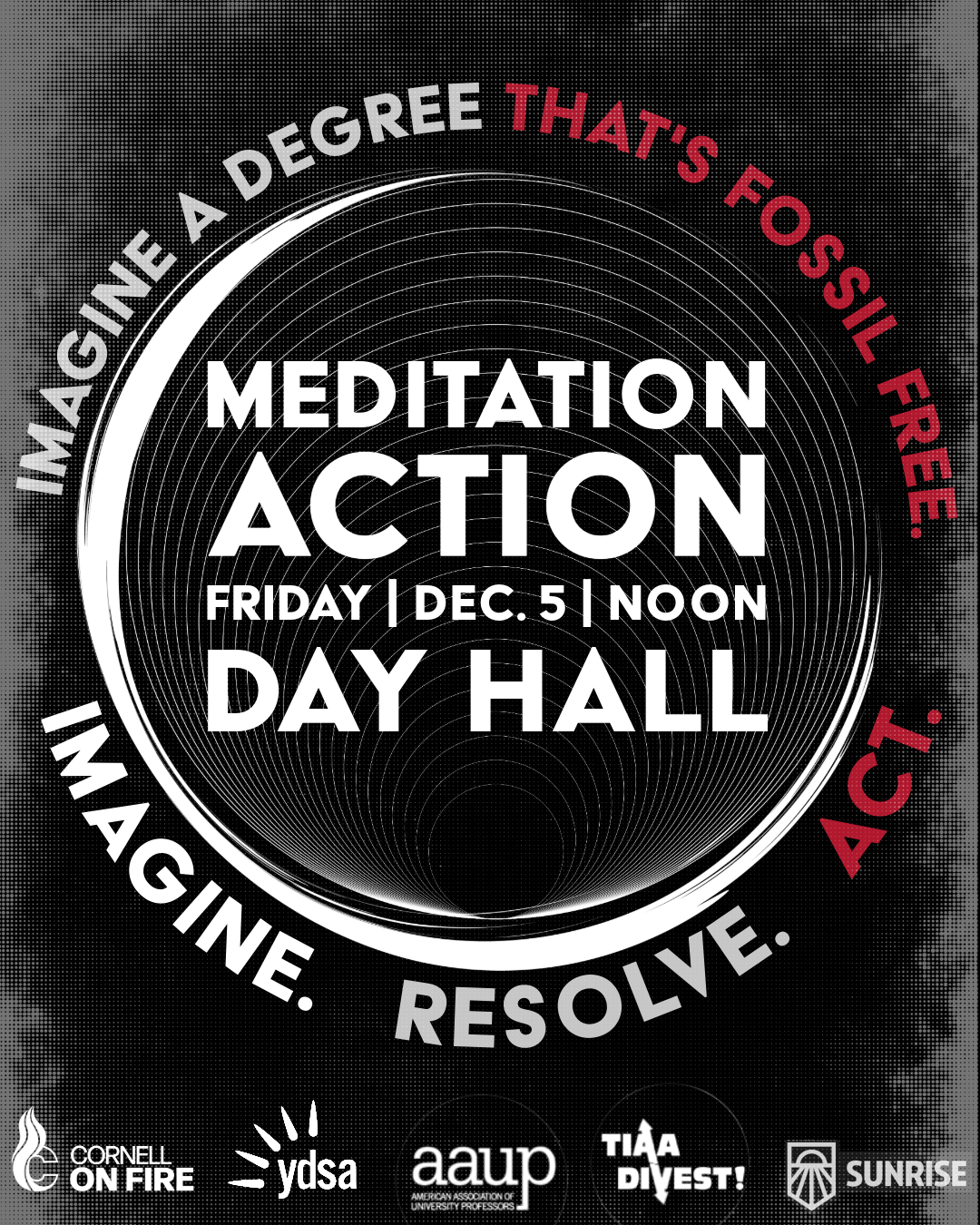
Meditation Action for a Fossil-Free Degree: Friday, 12/5, 1-2pm in front of Day Hall. Get enlightened at an unusual meditation! Join a 40-minute sitting-and-walking outdoor meditation led by an accomplished meditator with ceremonial sounds and activism scrolls, alongside an exclusive group of Cornell corporate bosses. Learn more and RSVP here. RSVPs are optional but will help us better prepare for your serenity amid climate breakdown. An unusual event co-sponsored by Cornell on Fire, Sunrise Cornell, Cornell YDSA, TIAA-Divest!, and the Cornell Chapter of the AAUP, inspired by Oli Frost and fossil-entangled Corporate Cornell.
Cornell on Fire Social: Sunday, 12/7, 4-6pm at Personal Best Brewery. A space to unwind and enjoy good company with fellow activists. Welcome!
Interested in joining our Working Group? We meet weekly on Tuesdays from 1-2pm and actively welcome new perspectives! Everyone can contribute to our campus-community coalition: students, staff, faculty, alumni, and community members. Fill out our interest form or reach out at connect@cornellonfire.org.
Join Cornell on Fire as a climate justice liaison. Our movement receives coalition requests from powerful movers and shakers on campus and beyond, such as the Rainforest Action Network, Campus Climate Network, and Scientist Rebellion Turtle Island. We need liaisons who can connect our work to theirs! This is a concrete way to support Cornell on Fire while driving the larger movement for climate justice. It’s easy: fill out our interest form to become a liaison who joins ally meetings and reports back to us.
Engage the Wider Movement:
Stop the TerraWulf Takeover on Cayuga Lake - and why it’s connected to Cornell: Local environmental allies are fighting a David-and-Goliath fight against TerraWulf’s data center plans in Lansing. TerraWulf is threatening lawsuits against town board members, disparaging town representatives and local reporters, and greasing the wheels with donations and tax revenue promises. Data centers’ high energy consumption jeopardizes our climate goals and increases utility prices while generating carbon emissions; noise, air and water pollution; and toxic e-waste that can seep into soil and groundwater. Data-center-driven AI is doubly extractive: it steals intellectual property from the working class while driving unemployment and cratering education.
What’s the connection to Cornell? According to our allies at TIAA-Divest, Cornell's major retirement fund, TIAA, identifies AI as a key driver of investment opportunities. TIAA’s portfolio includes substantial investments in data centers which are not apparent to those with TIAA accounts (people who have chosen real estate funds will not know that these accounts include AI data centers). In Aug. 2025, TIAA’s subsidiary Nuveen raised $1.3 billion for an energy and power infrastructure credit fund that will provide private credit to renewables, storage, hydrocarbon, and midstream and liquified natural gas companies benefiting from the AI boom. Private credit is unregulated and untransparent, unlike publicly traded stocks and bonds. There are lots of indicators that AI investments are a bubble, too, which will leave retirees with poor returns. If Cornell manages your tuition or your retirement funds, then you have a personal reason to oppose AI data centers like TerraWulf!
Stay plugged into the latest developments and take action with No Data Center FLX, @PSL_FLX, TIAA-Divest!, and Cornell YDSA.
Extinction Rebellion Climate Vigils 11am every Saturday at Chase Bank - the worst bank on Earth - at the East end of the Ithaca Commons.
In case you missed it. Catch up on our latest work:
Check out our latest actions:
Call to Action for TCAT: We blasted Cornell’s simultaneous betrayal of TCAT and their climate goals, asking our movement members to join Cornell YDSA’s phone zap. Our pressure helped! Days afterward, Cornell increased their offer - but not enough. Let’s keep up the pressure.
Fridays on Fire: Fight Bird Strike. Cornell climate activists fought bird strike and caught up with newcomers and oldcomers at our Fridays on Fire event. We introduced people to materials that can help prevent one of the largest killers of birds: windows. A collaboration between Cornell YDSA, Cornell on Fire, and Sunrise Cornell.
Cornell’s Climate Inaction Reviewed: Cornell on Fire Faculty Fellow Anthony Ingraffea presented on Cornell's (lack of) climate action to an engineering class. We published four key highlights and the results of a most revealing poll.
Thank you for reading this far and engaging in the number-one frontline for climate action: your attention.
Newsletter #23 originally published on November 25, 2025.