Love letter to our critics
When love is disruptive
Newsletter #26 published February 13, 2026

Newsletter #26 is a love letter to our critics. This valentine speaks to those who find our work too confrontational, too satirical, or too disruptive. We explain why we’ve chosen our course on these issues: Namely, because Corporations like Cornell don’t have a conscience. We are your bad conscience – and a conscience is love in action. Compassion moves us to call out carbon injustice. But we are not always agreed or certain that we’re right. If you still disagree with our methods after reading this valentine, please continue to let us know – and please continue to pursue the same goals your way!
Scroll below for upcoming events and to get involved!
Dear Critics of Cornell on Fire,
We love you. Thank you for urging us to consider all the implications of our work, intended and unintended. We compose this valentine to share why we’ve chosen our course on issues where you’ve called us perverse, wrong, or mean-spirited.
While we address Cornell the Corporation, we are painfully cognizant that the Corporation is made up of people – people who may be offended by our message, tone, or challenge to their public claims.* Tragically, the climate crisis is being caused by good people continuing to do things the way they’ve always been done.
Earth is burning because good people continue catering to the appetites of corporations and careerism over the needs of earth and their fellow beings. Compassion does not compel us to overlook Cornell’s climate hypocrisy because its staff are good people. Compassion moves us to call it out.
Disruptive moral emotions are necessary
Some say we’re too harsh in calling out Cornell’s climate injustice, construing this as “shaming and blaming.” They do not speak about the harshness – indeed, deadliness – of Cornell’s carbon pollution and climate inaction. It is our intention to reveal the harsh consequences of Cornell’s luxurious paralysis in the face of crisis.
The social organization of denial among carbon-privileged people preserves their identity as "sustainable, good people" by employing "tools of innocence" that enable them to avoid feelings of guilt, shame, self-involvement, or any personal/collective accountability to the climate crisis. Yet these moral emotions, when they point us to the truth about what is happening, are essential to having a conscience: they are productive, appropriate, and a key outcome of successful nonviolent action. It is our work as activists to shift this culture of denial towards awareness and accountability – however uncomfortable and unpopular this message (or we) may be.
Why we are not positive, polite, and affirming towards Cornell decision-makers*
First, administrators will not seriously engage with us unless and until we exert such pressure that they cannot avoid it. This should be self-evident, but we’ve also confirmed it through experience.* Activists work within a class hierarchy: We have no institutional backing so we must act through external pressure. Knowing this, Cornell’s chief mode of opposition is to attack our credibility. They paint us as threats to infrastructure, heartless critics, radical propagandists, and ban us from campus while threatening arrest. Critics who think we can cajole decision-makers into changing their ways overlook this class dynamic.
Second, we don’t believe change will happen by persuading Cornell leaders – it will happen through resistance that compels them to change, just as their present climate hypocrisy is compelled by sociopolitical forces. The power of administrators and trustees is contingent upon the continued cooperation and complicity of the larger community. Our work addresses and mobilizes the community, not Cornell’s apparent powerbrokers.
Third, we cannot highlight Cornell’s “positive” climate actions because Cornell hasn’t come close to an honest reckoning with their role in the climate emergency and carbon inequality. It may be doing only slightly worse than peer institutions, but wrong doesn’t become right because “everyone else” is doing it. That things are status quo is the catastrophe.
Why we use satire, sarcasm, and irony
When you’re punching up, satire is a powerful tool. Nothing exposes hypocrisy so efficiently. Comedy is the art of the underdog, and it’s only funny because our audience sees that the administration's true priorities are absurd. The administration has power, money, and armies of staff. We have only honesty, comedy, and (we submit) the moral high ground.
It’s fashionable among university-educated elites to disdain sarcasm as the cultural tool of nonelites. Some call sarcasm “violent communication” while ignoring the unspeakable violence of their carbon-polluting social rank, which allows them to export harm to “the institutions that wield violence on one’s behalf” (p. 10).
We also use satire because it’s irreverent by design: It reminds powerbrokers that their power is contingent upon public credibility, and we aren’t buying it.
With all our love
Dear critics, we hope that you can see that we’ve been sending you love letters all along.
Corporations like Cornell and systems like capitalism don’t have a conscience, but each of our natural human critics does.* To quote activists from another time and place: “We are your bad conscience.” A conscience is love in action. It brings in the silenced voices who are harmed by one’s privileges, profits, and PR, and whispers, “Is this justice? Are you being accountable to all beings who live downstream?”
A conscience is the organic wellspring of disruptive emotions. Its job is to confront us when our actions conflict with our values. Our mission is to direct this confrontational spirit both inwardly and outwardly: We call on Cornell, and ourselves, to confront the climate emergency and the carbon privilege that stokes it. When we ask Cornell – and you – to take risks, be honest, and make brave tradeoffs, we call on ourselves to do the same.
This is the hardest part of activism: We’re not always agreed and certain that we’re right. If we can do better, please continue to let us know. And if after reading this you are still offended by our methods - PLEASE pursue the same goals your way!
With love,
Cornell on Fire
Postscript:
“My heart is moved by all I cannot save:
So much has been destroyed
I have to cast my lot with those
Who age after age, perversely,
With no extraordinary power,
Reconstitute the world.”
-Adrienne Rich
*Asterisks indicate where supplemental notes can be found by scrolling below. Read on for actions, events, and updates! This newsletter was also published via email and social media on Instagram and Mastodon.
Get involved with Cornell on Fire:
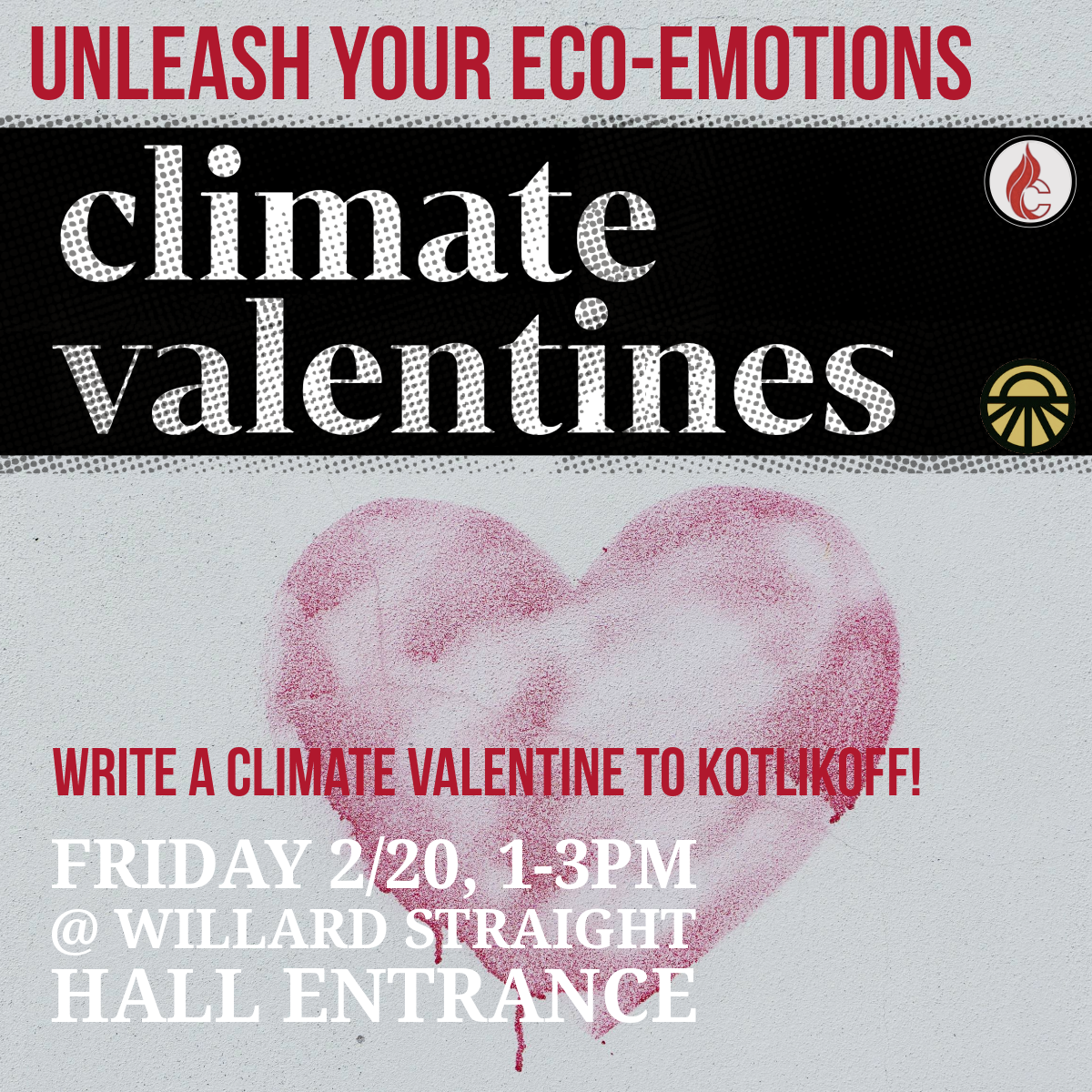
Climate Valentines: Friday, 2/20, 1-3pm at Willard Straight Hall Entrance. Drop by to make a climate valentine for President Kotlikoff! Show some love for earth and tell our university leadership they should too. A Fridays on Fire collaboration between Sunrise Cornell and Cornell on Fire.
Cornell on Fire Monthly Meeting: Saturday, 2/28, 2-4pm at St. Luke Lutheran Church in Collegetown (109 Oak Avenue. We also meet hybrid - email us if you’d like the link!)
Cornell on Fire Social: Sunday, 3/8, 3-5pm at Stonebend Pizza. A space to unwind and enjoy good company with fellow activists. Welcome!
Meditation Action for a Fossil-Free Degree: Friday, 3/20. Learn more and RSVP here. An unusual event co-sponsored by Cornell on Fire, Sunrise Cornell, Cornell YDSA, TIAA-Divest!, and the Cornell Chapter of the AAUP, inspired by Oli Frost and fossil-entangled Corporate Cornell.
Interested in joining our Working Group? We meet weekly and actively welcome new perspectives! Everyone can contribute to our campus-community coalition: students, staff, faculty, alumni, and community members. Fill out our interest form or reach out at connect@cornellonfire.org.
Join Cornell on Fire as a climate justice liaison. Our movement receives coalition requests from powerful movers and shakers on campus and beyond, such as the Rainforest Action Network, Campus Climate Network, and Scientist Rebellion Turtle Island. We need liaisons who can connect our work to theirs! This is a concrete way to support Cornell on Fire and the larger movement for climate justice. It’s easy: fill out our interest form to become a liaison who joins ally meetings and reports back to us.
Contribute your creative skills to Cornell on Fire’s art-ivism project: We are seeking people with design and artistic skills to help create humorous, critical, multi-media artworks for a public exhibit about Cornell’s shortcomings in the face of the climate emergency and CoF demands. Get in touch with Leila at l.wilmers@gmail.com for details!
Engage the Wider Movement:
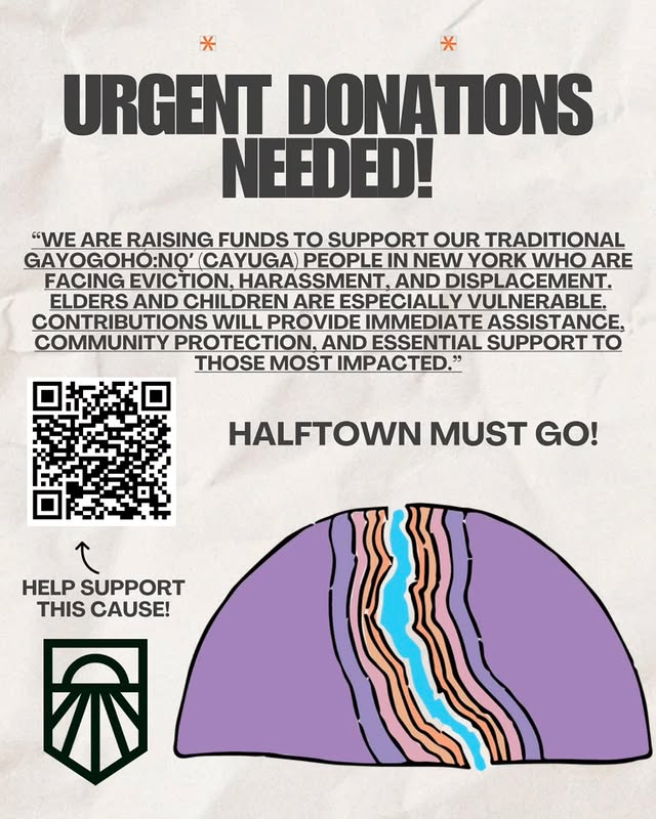
Support the Gayogoho:no’ (Cayuga) People: Sunrise Ithaca and others are raising funds to support our traditional Gayogoho:no’ neighbors in New York who are facing eviction, harassment, and displacement. Elders and children are especially vulnerable. Contributions will provide immediate assistance, community protection, and essential support to those most impacted. Halftown must go! Support the cause and donate here.
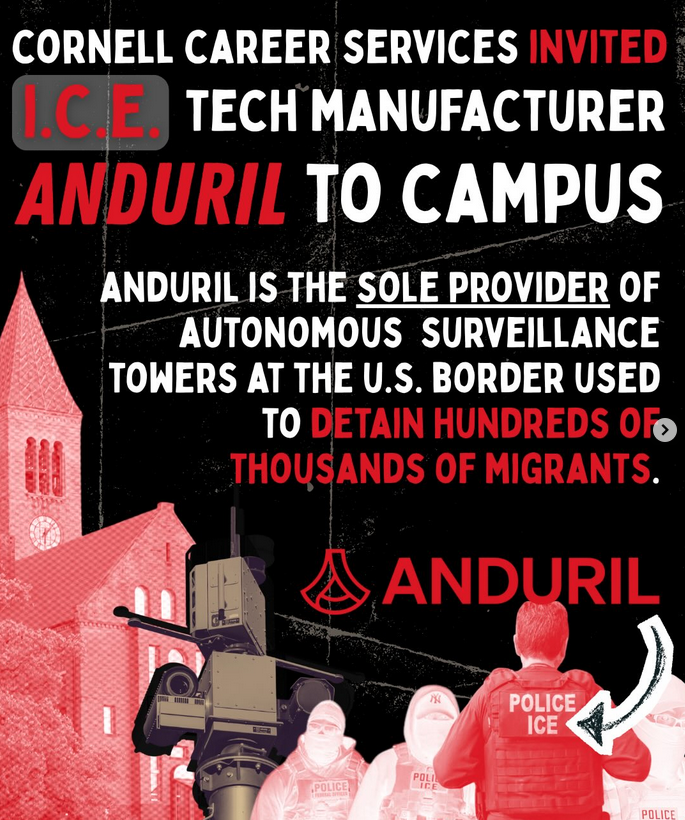
An important message from CU Progressives: Cornell has invited ICE tech manufacturer Anduril to campus next week. Our goal is to pressure Career Services to cancel this event and end all collaboration with ICE. Please spread the word and encourage people to send an email using this template (takes 30 seconds!).
Extinction Rebellion Climate Vigils 11am most every Saturday at Chase Bank - the worst bank on Earth - at the East end of the Ithaca Commons.
In case you missed it. Catch up on our latest work:
Check out our latest communications:
Read the press coverage of our activities over the last months.
Follow our latest actions on social media: on Instagram, Mastodon, and YouTube.
SUPPLEMENTAL NOTES
*We address Cornell the Corporation, not individuals: The exceptions are the acting President or Provost, who take on the mantle of responsibility for Cornell University’s policies. We recognize that these actors are highly constrained in their actions. Still, they serve as figureheads vested with the power to speak on behalf of the university and therefore carry both public prestige and accountability for forces larger than themselves.
*Our critics would prefer polite, positive language. It is worth considering that when our critics tell us to be polite and adjust our tone, they may be saying that they are uncomfortable directly calling out their employer with raw honesty. Anthropologists point out that the bourgeois subject is “unique in glossing dishonesty itself with positive valences in vocabulary such as “tact,” “discretion” and “professionalism,” these being ethnographic categories referring to lies one must tell to keep one’s social capital stocked and protected” (p. 12).
*Decision makers will not meet with us until significant pressure is exerted. For the record, we have tried to invite decision-makers into conversation with us and it didn’t work. Two years ago, our team tracked down the mailing addresses of every person on Cornell’s uniquely large Board of Trustees. Each trustee received a customized hand-written card thanking them for their work, pointing to our common climate interests and our shared love of Cornell, and asking them to meet with us. Over 70 cards went out. Not a single response came in. Dead silence…except our webpage registered a spike in traffic after the cards were received, perhaps suggesting that these actors had received an email from Cornell administrators advising them on how (not) to respond to our cards.
We have also delivered multiple messages to Presidents Pollack and Kotlikoff requesting a meeting. We received only one polite, brief email from President Kotlikoff declining to meet. He also penned an op-ed casting our work as “fault-finding” rather than “fact-finding.” (Inexplicably, he was criticizing our technical white paper that is exclusively focused on assessing the facts around campus decarbonization solutions.) We have also invited collaboration with various actors within Cornell’s energy and sustainability teams. With few exceptions, the blanket policy is to vehemently ignore us. We respect Cornell actors but that doesn’t mean we adopt a foolishly conciliatory posture.
*Corporations do not have a conscience: Corporations are not bothered when they make empty climate pledges. Cornell the Corporation works overtime to protect its reputation, rankings, and bottom line, but it has no accountability mechanism to bind itself to its Climate Action Plan. This lack of accountability is by design. It’s no surprise that corporations have captured the climate emergency and twisted it into a PR tactic by broadcasting their climate pledges far and wide while facing no consequences for missing them. Cornell in particular misrepresents its progress toward climate goals while enforcing a calculated silence around its failure to meet its major climate pledges.
Thank you for reading this far and engaging in the number-one frontline for climate action: your attention.
Newsletter #26 originally published on February 13, 2026.
Opt out of Cornell on Fire Newsletters: write “unsubscribe” to connect@cornellonfire.org or click “unsubscribe” below.