Students want climate action
Will Cornell act on student resolutions and concerns?
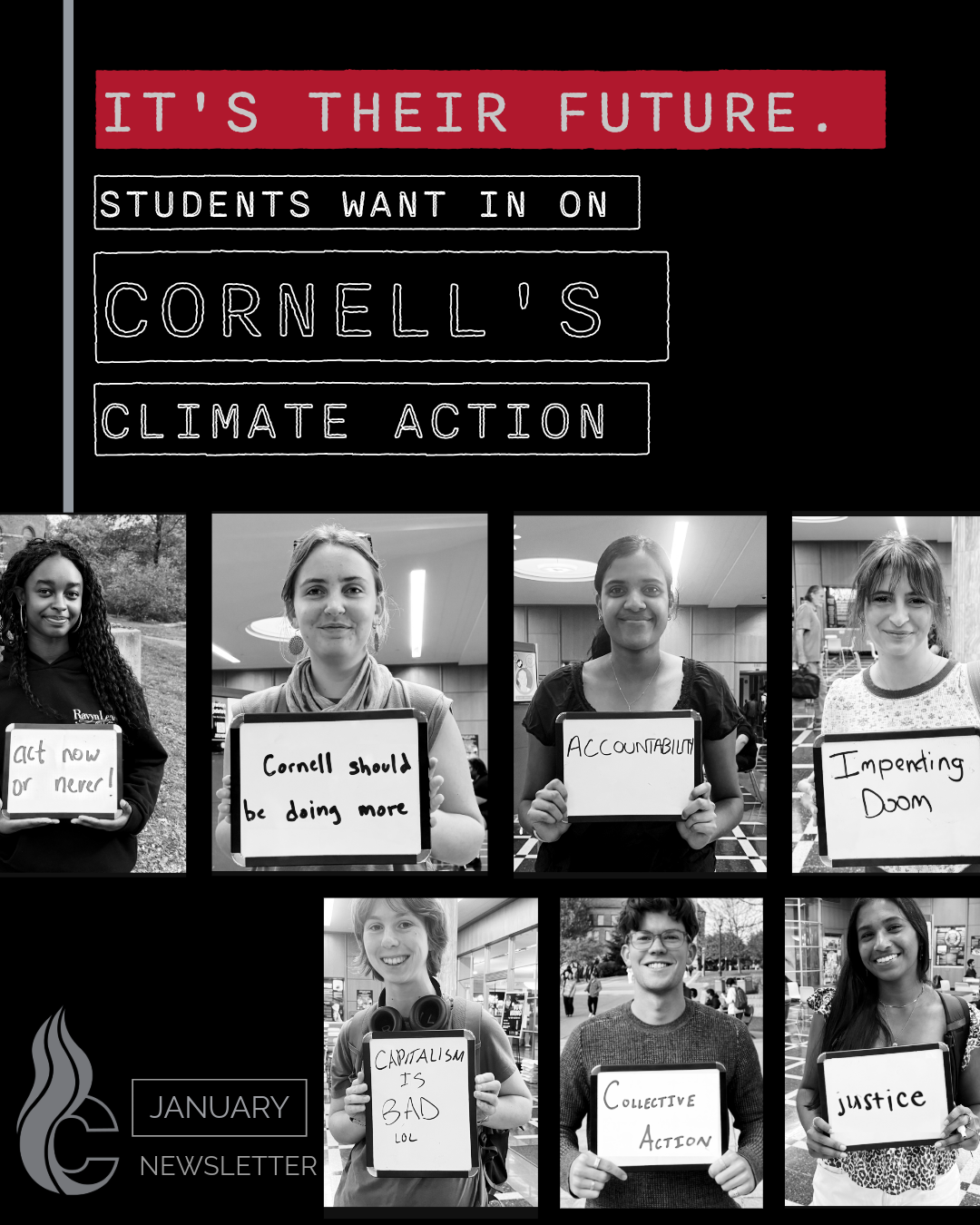
Newsletter #25 brings you student views on the climate crisis and Cornell’s role in it. As a freshly passed Student Assembly resolution asks Cornell to cut ties with fossil fuels, new student research projects shed light on the knowledge and sentiment behind collective appeals on this topic from across campus, and on peers’ personal journeys through climate breakdown. Students are asking for more from Cornell. Will the administration listen?
Dear Cornell on Fire,
In this tumultuous start to the year, we are grateful to still be here with you and energized to keep alive the fire of dedication to a better trajectory for our community, Earth and all beings living on it. With the first week of classes in full swing, it’s time to take stock of what students are learning about the climate crisis and Cornell’s role in it, and how they feel about it all.
Just before campus emptied out for winter break, the Student Assembly unanimously passed Resolution 19: University-Wide Disassociation, calling on Cornell to dissociate from fossil fuels and all aspects of the fossil fuel industry, stating that the university’s ties to the industry are inconsistent with its role as a “global leader in sustainability”. This is not the only recent appeal from the student body to the university on this front. In January 2025, the Assembly passed Resolution 20: Climate Renewal Vows, requesting Cornell enhance its Climate Action Plan to fulfill its obligation to its students, community, and its global leadership role. A few months earlier, the student group Fossil Free Cornell had published a report, covered by The Guardian, exposing Cornell’s links to fossil fuel industries and asking the administration to end them. The only response from President Kotlikoff has been to offer an update from the Campus Sustainability Office on measures Cornell is already taking to address the climate crisis. As we documented, current measures fall far short of what is needed, and are even inadequate to meet Cornell’s own carbon reduction targets. Students’ concerns expressed through the resolution, the principal official channel available to them, are being consistently disregarded in favor of other interests.
What kinds of knowledge and sentiment do collective expressions of student concern reflect? According to the results of a survey taken at enrollment, 98.5% of incoming Cornell undergraduates are “concerned about the state of the environment”. This chimes with a broader trend of high climate anxiety among young people in the US. In Fall 2025, a group of students highlighted the perspectives of their peers with a Climate Solutions Capstone project in NTRES/ENVS 4500. A collage of students’ words of concern superimposed onto images of their faces is a striking reminder of the lives behind the numbers on climate anxiety.
Students come to Cornell with their own personal journeys through climate breakdown. You get a feel for this reading three blogs written by the project authors. In one, they write of an interviewee originally from India: “Growing up in an environment where water could run out at any time instilled a sense that environmental responsibility was simply part of being a citizen.” Another interviewee links her awareness of climate change to having lived through devastating hurricanes in her home city of Miami. As climate breakdown unfolds, more Cornellians will arrive with first-hand experience of the stakes involved in this crisis.
Does a Cornell education equip students for success in the reality ahead? A student study conducted last semester as part of PSYCH 4430: Confronting Climate Change found most students surveyed had not taken a course that integrated climate change topics. The study reported strong concern about climate change, but a weak sense of agency to contribute to meaningful change, and poor awareness of Cornell’s climate action goals and progress. The author suggests Cornell could do much more to “create environments where sustainable behaviors are the default rather than the exception.” On this we welcome a positive sign: a report of Cornell’s Climate Change Curriculum Working Group included in its final recommendations a requirement that "undergraduate students take a climate change specific course or one or more courses that include climate change content."
A report by another PSYCH 4430 student team showed the campus community “is generally concerned about sustainability and food systems but lacks the information, transparency, and structural support needed to fully engage in effective food-waste reduction.” Lack of knowledge about Cornell’s climate action was also noted by interviewees of the capstone project group. We hear only of successes at Cornell’s restricted-entry annual State of Sustainability addresses. In contrast, elsewhere, universities are opening up debate about the challenges and potential new approaches. Informing students of climate action on campus and creating avenues for their input would empower them to grapple with trade-offs, contribute to solutions, and be less isolated in their concern.
Following the latest Student Assembly resolution, capstone class participants wrote to President Kotlikoff. They urged:
“Sit down with and create meaningful relationships with students, faculty, staff, and community members who want to talk to you about what Cornell can do better in the fight against climate change. We want to work with you, and we think it is about time that this type of real and transformative work begins.”
As the semester opens, we wait for Cornell administration to act on the Student Assembly resolutions, and develop democratic processes that give students a say in designing and implementing action on this existential issue. Students need to be involved, and we all need them to be if we want tomorrow’s leaders to be equipped to lead.
Awaiting action,
Cornell on Fire
Read on for actions, events, and updates! This newsletter was also published via email and social media on Instagram and Mastodon.
Get involved with Cornell on Fire:
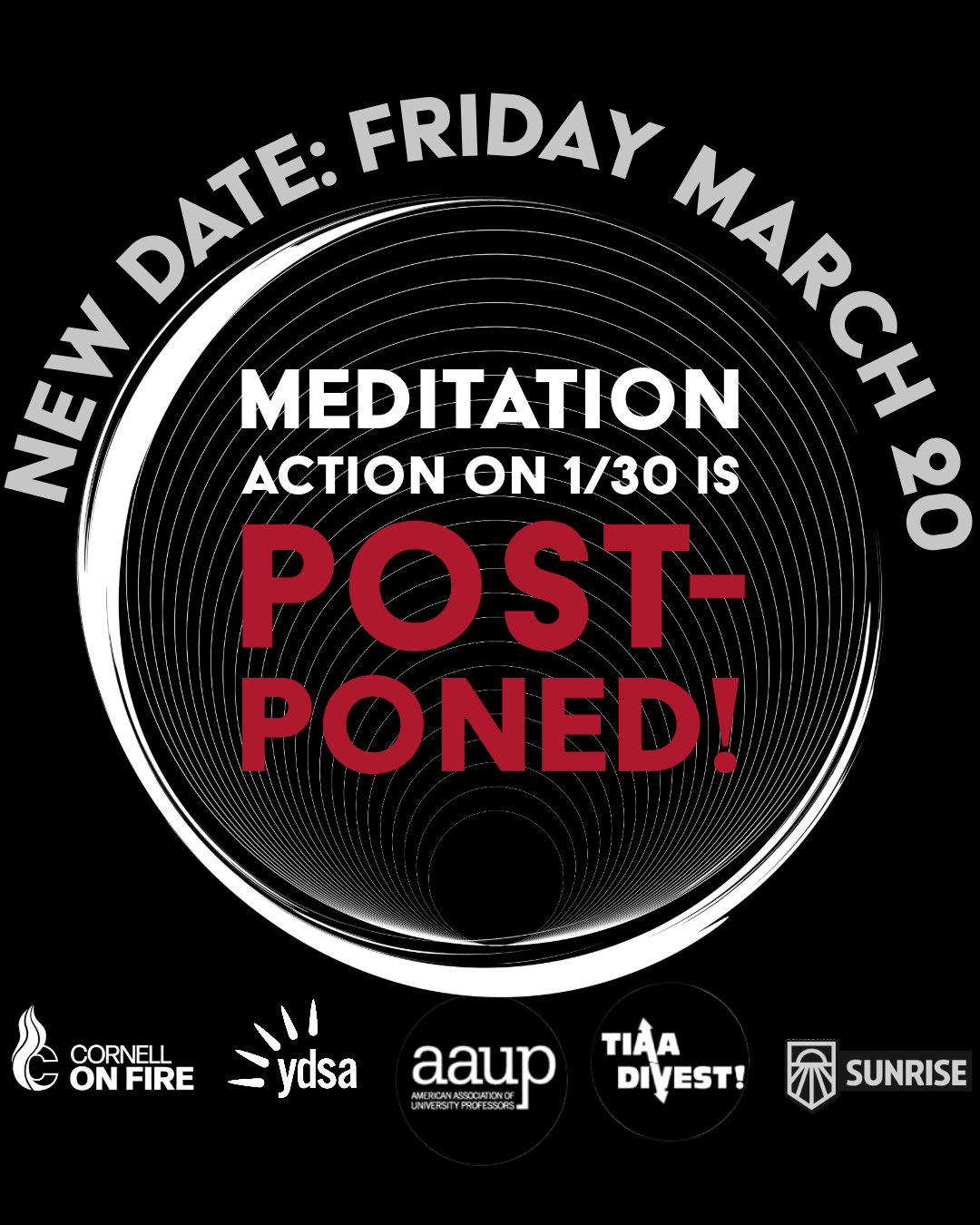
Meditation Action for a Fossil-Free Degree: POSTPONED! Due to freezing temperatures, our meditation action originally scheduled for this Friday is postponed until Friday, March 20. Learn more and RSVP here. An unusual event co-sponsored by Cornell on Fire, Sunrise Cornell, Cornell YDSA, TIAA-Divest!, and the Cornell Chapter of the AAUP, inspired by Oli Frost and fossil-entangled Corporate Cornell.
Cornell on Fire Monthly Meeting: Saturday, 1/31, 2-4pm at St. Luke Lutheran Church in Collegetown (109 Oak Avenue - also hybrid. Email us if you’d like the link!)
Interested in joining our Working Group? We meet weekly and actively welcome new perspectives! Everyone can contribute to our campus-community coalition: students, staff, faculty, alumni, and community members. Fill out our interest form or reach out at connect@cornellonfire.org.
Join Cornell on Fire as a climate justice liaison. Our movement receives coalition requests from powerful movers and shakers on campus and beyond, such as the Rainforest Action Network, Campus Climate Network, and Scientist Rebellion Turtle Island. We need liaisons who can connect our work to theirs! This is a concrete way to support Cornell on Fire while driving the larger movement for climate justice. It’s easy: fill out our interest form to become a liaison who joins ally meetings and reports back to us.
Contribute your creative skills to Cornell on Fire’s art-ivism project: We are seeking people with design and artistic skills to help create humorous, critical, multi-media artworks for a public exhibit about Cornell’s shortcomings in the face of the climate emergency and CoF demands. Get in touch with Leila at l.wilmers@gmail.com for details!
Engage the Wider Movement:
Are you concerned about climate change? We are researchers at Cornell University who are interested in talking with people about how they are thinking about [not] having children in an era of climate change. Please see our recruitment flyer for more details about the study and eligibility. You can contact us at either jamie.budnick@cornell.edu or acc382@cornell.edu if you are interested in participating. The flyer indicates only Zoom interviews, but we are also available to do interviews in-person for those residing in the Ithaca area. Thank you!
In case you missed it. Catch up on our latest work:
Check out our latest communications:
Newsletter #24: Cornell Sustainability Summit: Seasonal Sadness
Read the press coverage of our recent activities.
Check out our latest actions:
Call to Action for TCAT: Cornell needs to allocate more funding to support TCAT. Let’s keep up the pressure. Fill out this form if you want to join the coalition effort!
Follow our latest actions on social media: on Instagram, Mastodon, and YouTube.